






Quantifying the health benefits of the Decent Homes programme FB 64
BRE ( Building Research Establishment ) is an independent, research-based consultancy, testing and training organisation, operating in the built environment and associated industries.
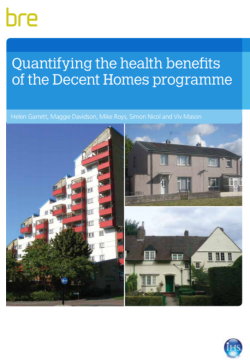
Decent housing is a preventative service that helps to reduce costs to the NHS, for example, by providing the right environment for people to stay safe and well, to be treated in or closer to home when they are ill and to recover quickly from episodes of ill health after a shorter time in hospital.
Quantifying the health benefits of the Decent Homes programme (FB 64) was written by Helen Garrett, Maggie Davidson, Mike Roys, Simon Nicol and Viv Mason and published by BRE on 14 Apr 2014.
This 40-page report quantifies how much the improvements to social housing arising from the Decent Homes programme (2001–2010) have reduced the costs to the NHS of treating housing-related injuries and illnesses. It uses the same methodology developed to calculate the costs of poor housing in England described in BRE’s 2010 report The real cost of poor housing.
The report also discusses:
- The additional costs to society of non-decent homes.
- The impact of less serious, but still significant levels of Housing Health and Safety Rating System (HHSRS) hazards.
- The work that remains to be done in terms of dealing with homes that are still non-decent.
- The importance of maintaining standards in dwellings that are currently decent.
Its contents include:
- Foreword.
- Executive summary.
- Introduction.
- Overview of methods and background.
- Estimating the actual reduction in hazards between 2001 and 2010.
- Estimating the cost of work required to make homes decent.
- Estimating the reduction in costs to the NHS.
- Additional costs to society of non-decent homes and the benefits of improving them.
- What is left to do.
- Conclusions.
- References.
- Appendices.
[edit] Related articles on Designing Buildings Wiki
- BRE articles on Designing Buildings Wiki.
- BRE Buzz articles on Designing Buildings Wiki.
- BREEAM.
- Building Research Establishment.
- Decent Homes for Ageing Well.
- Decent homes standard.
- Housing contribution to regeneration.
- The cold man of europe 2015.
- The cost of poor housing to the NHS.
- The cost-benefit to the NHS arising from preventative housing interventions (FB82).
- The full cost of poor housing.
- The full cost of poor housing in Wales.
- The real cost of poor housing.
Featured articles
Check out some of the best features and news from Designing Buildings as well as key stories from around the web.

Government launches a one stop shop for flood preparedness.

Sir Edwin Lutyens: Britain's greatest architect? Book review.

CIOB publishes free template to help assess and manage risks.
ECA's reflections on Party Conference season

Burnham wants to be confident of winning before asking for a fresh mandate.
New Chief Construction and Scientific Adviser

Sergio Cavalaro, Professor of Infrastructure Systems at Loughborough University.
Building safety levy for England

CIAT publish estimator tool for members.

Water sector faces a growing crisis that could slow the delivery of vital infrastructure.
Undervaluing our industrial past

Heritage value changes as taste for building styles changes.
Changing expectations around competence and compliance

New information sheet from CIAT.
Grenfell investigation files passed to CPS

Angela Rayner apologises on behalf of the British state.

Electrical contractors need to understand the practical implications.

The real barrier to getting more value from digital technology.